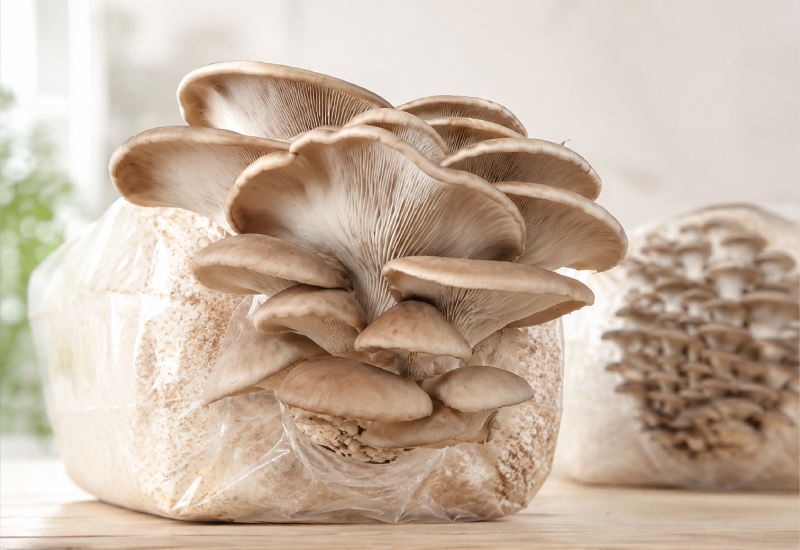
Bundles of oyster mushrooms
Oyster Mushroom DIY Kit
DIY TABLE KIT
Bundles of oyster mushrooms
Oyster Mushroom DIY Kit
DIY TABLE KIT

DIY Mushroom Kit

  • 🍄 ORGANIC DIY OYSTER MUSHROOM KIT: Everything you need in one box to make your own fruiting blocks .
  • 🌱 EASY TO GROW: Super simple to do at home, at school, with your kids, or with your friends—just follow our instructions.
  • 💪 HIGH YIELD: 0.6 to 1 kg per bale.
  • 🍽️ NUTRITIONAL VALUE: Oyster mushrooms are rich in protein, vitamins, and minerals, making them perfect for a balanced diet.
  • 🌍 ORGANIC PRODUCTION: Certified "BE-BIO-01," pesticide-free and GMO-free, environmentally friendly.
  • STORAGE: You can store the mycelium in the refrigerator for up to 1 month until you're ready to use it.
€24.50 Sale
- +


Welcome to the adventure of growing mushrooms! This kit makes it easy to grow your own mushrooms, whether at home, at school, or with friends. Discover the joy of watching your oyster mushrooms grow and harvesting them.

Prep time: 30 minutes
; Time until harvest: 4 to 6 weeks

Storing the Mycelium
If you do not plan to use it within a week of receiving it, store the mycelium in the refrigerator for up to 1 month.


      Growing Steps

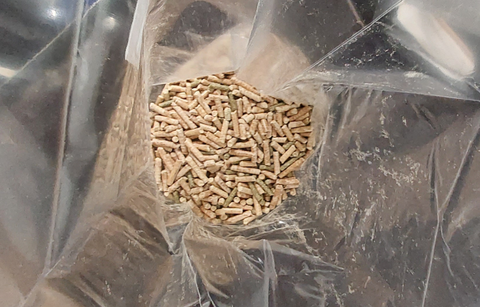
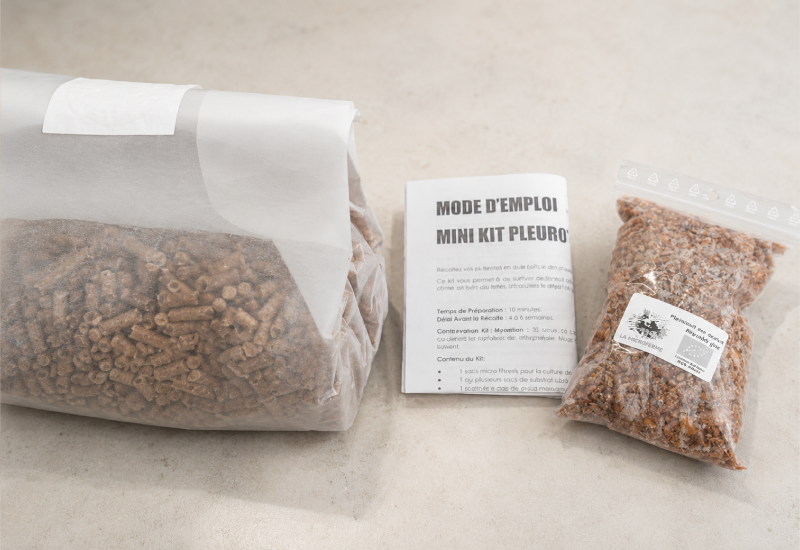
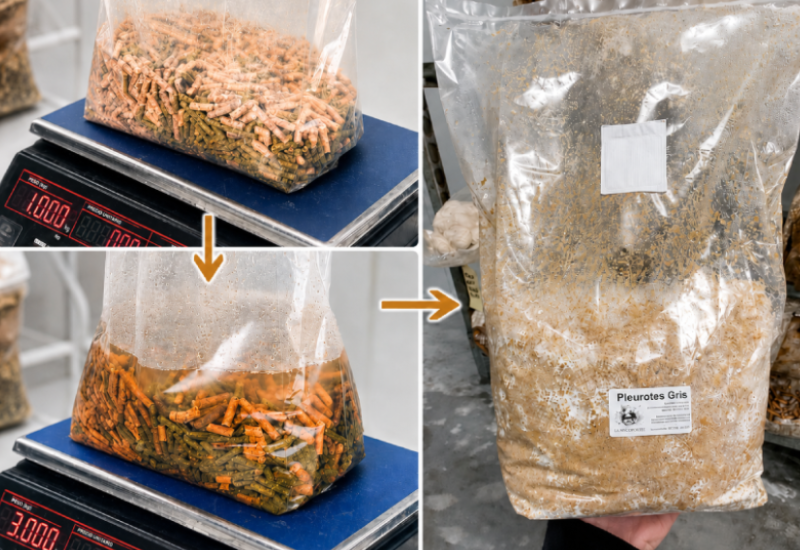
      Pellets, straw, bags

      Start by cleaning all work surfaces with soapy water, as well as your hands and forearms. Work in a clean environment.

      1. Preparing the Bags
        Divide the lime among the 5 bags (one teaspoon per bag). Add 2 liters of water per bag and let the pellets absorb the water (about 5 minutes).
        For the mini-kits, the lime is already included in the pellets. The purpose of the lime is to enrich the substrate with calcium and raise the pH (= alkalize) to limit the growth of bacteria and mold. Since lime can be slightly irritating to sensitive skin, avoid contact or wash your hands afterward.

      2. Adding Mycelium
        Add approximately 300g of mycelium per bag.

      3. Sealing Bags
        Seal the bags with tape or a sealer.


      4. Mix Gently mix the bags to distribute the mycelium evenly throughout the substrate.

      5. Colonization
        Leave the bags for 2 weeks at approximately 20 °C in the dark to allow the mycelium to fully colonize the substrates.

      6. Opening the "
        " bag: Squeeze the air out of the bag and make a 5–10 cm slit on the side of the bag at the level of the substrate to allow the oyster mushrooms to grow. We recommend covering the filter with tape at this point to prevent the mushrooms from trying to escape through it.

      7. Humidity
        Maintain humidity by misting daily or by placing the bag on a large plate with a damp cloth underneath.

      8. Growth
        Oyster mushrooms will begin to grow and open up in 1 to 2 weeks.

      9. harvest
        Harvest them before the caps open up and release their spores. Be careful—they grow fast! If you harvest them a little later, it’s no big deal, but they might be a little less tender and flavorful.

        DIY oyster mushroom kit

        Each bag can produce 2 to 3 harvests: A total of 600 g of oyster mushrooms per bag, or 3 kg for the 5 bags. After each harvest, let the bag rest for 3–5 days before rehydrating it by soaking the substrate overnight in a basin of water.

        To space out the harvests, place some of the bundles in the refrigerator or in a cooler room after they have been planted.

        Objects made of mycelium?

        You can also try the "MycoMaterials" mode to create objects made of mycelium by selecting the "reishi" variety. For more information, check out our tutorial on MycoMaterials.

        Should I choose the Mini or the Maxi DIY Kit?

        DIY Mini Kit

         DIY Maxi Kit

        ✔️ 1 bag with a breathable microfilter ✔️ 5 bags with breathable microfilters
        ✔️1 kg of straw pellets (certified organic) and lime ✔️ 5 kg of straw pellets (certified organic) and slaked lime
        ✔️ 300 g of oyster mushroom mycelium ✔️ 1.5 kg of oyster mushroom mycelium
        ✔️ Instructions for Use ✔️ User Guide

        ✔️ Pair of gloves

        ✔️ 1 mini spray bottle
        👉 harvest yield harvest 0.6–1 kg of oyster mushrooms 👉 harvest yield harvest 3–5 kg of oyster mushrooms

        Precautions 

        • Work as cleanly as possible: wash your work surfaces and your hands before you begin.
        • Even though it is slaked, lime can still irritate your hands. Avoid direct contact, or wash your hands immediately.
        • Harvest times may vary depending on temperatures. Cold weather slows down the fungus's metabolism, which can affect the timing of harvests.
        • It is recommended that you use the mycelium all at once. If you do plan to use it in several sessions, be sure to work cleanly and reseal the bag tightly after each use. Store it in the refrigerator and use it within 2–3 weeks.

        Important Note: Most mycelium is made to order. Depending on availability, delivery may take 1 to 3 weeks.

        Educational Kit 

        If you want to organize an activity with your students or children about mushrooms, this is the perfect kit.

        Mushroom Educational Kit

        Learning Objectives

        • Understand what a fungus is and its role in nature.
        • Explore the life cycle and metabolism of fungi.
        • Learn about the different kingdoms of living organisms and the classification of fungi.
        • Raise participants' awareness of the importance of fungi in ecosystems.
        • Identify the main families of fungi.

        Topics Covered

        1. Definition of a Mushroom
          It is important to understand that a mushroom is the fruiting body of a mycelium, not a plant.

        2. Fungal Metabolism
          Exploring how fungi feed and grow.


        3. 's Life Cycle of Fungi Observe and explain the stages of a mushroom's growth.

        4. Kingdoms of the Living
          : Classifying fungi within the biological classification system.

        5. Ecological Role
          Discuss the importance of fungi in ecosystems, both as decomposers and symbionts.

        6. Families of Fungi
          Learn about the characteristics of the main families: Basidiomycetes (such as oyster mushrooms), Ascomycetes, and Zygomycetes. Understand the differences in how saprophytic, symbiotic, and parasitic fungi function.


          Science Project Ideas About Mushrooms for Kids

          • Compare Environments

          Get two mushroom growing kits of the same type and slightly alter their growing conditions. The main factors affecting mushroom growth are humidity, light, and airflow. You can try changing the amount of moisture in one kit, the amount of sunlight one kit receives, or the amount of airflow in one kit. The kit that receives different conditions is the experimental kit. Keep the other kit under ideal conditions as a control and observe what happens! Remember, change only one factor at a time to get the best possible data! Does this change the number of mushrooms that grow? Does this change the distribution of mushrooms on the block? Do the mushrooms in the experimental kit look different? Record your observations!

          • Describe and Identify Mushrooms

          Even though you already know what kind of mushrooms your kit will grow, you can practice identifying mushrooms using your kit. Take photos or draw your mushrooms as they go through the different stages of growth, and demonstrate how to use the following techniques to identify mushrooms:

          Look at the mushroom: What color is the cap? What shape is the stem? Is the cap convex, flat, or conical?

          Look under the cap for spore-producing structures. Does the mushroom have gills, pores, or teeth? Does the mushroom have warts, a veil, or a ring?

          Touch the mushroom: Is the top of the cap smooth? Velvety? Dry? Scaly? Is the stem (or stipe) fuzzy or fibrous?

          Smell the mushroom: Many mushrooms can be identified by their smell. These smells can range from the typical mushroom scent we’re all familiar with from button mushrooms, to a rotten odor, or even a scent reminiscent of almonds or cinnamon.

          • A spore print

          Remove the stem from the cap and place the cap gills-side down on a sheet of paper. Some mushrooms (such as shiitake) produce white spore prints, so you may want to make one on white paper and one on colored paper. Cover the mushroom caps with a bowl or other lid to prevent drafts from blowing the spores away, and leave them for a few hours. After waiting, you should be able to carefully lift the mushroom caps and see the spores left behind on the paper! Mushrooms leave spore prints in many different colors, so this is a useful technique!

          You can also find a wild mushroom (in the fall or spring) and compare your observations between the mushrooms you’ve grown at home and the wild ones! Please note: Wild mushrooms should never be eaten without being 100% positively identified!

          • Propagate the mycelium

          Take a nice piece of mycelium and mix it with various substrates such as coffee grounds, pasteurized straw, cardboard, wood chips, etc. Observe how it reacts and whether or not the mycelium manages to colonize these different substrates.

          • Examine under a microscope

          If you have a microscope, you can observe the "hyphae" (filaments of the mycelium) or the mushroom spores. Compare them with other varieties of mushrooms collected in the wild, for example.

          These are just a few ideas for science projects on mushrooms; use your imagination! Be curious! Ask questions, and see if your mushroom growing kits can help you answer them! Mushrooms have a lot to teach us about their life cycle, their ecosystem, and the global environment. But most of all, have fun!

            Customer Reviews

            Based on 25 reviews
            84%
            (21)
            12%
            (3)
            4%
            (1)
            0%
            (0)
            0%
            (0)
            F
            Fay G.
            great

            Great! I love the process, and the packaging and instructions were spot on.

            A
            Anonymous
            very

            very good

            a
            Alain C.
            It looks like good quality

            It looks like a quality product. Plus, it ships quickly.

            R
            Romuald C.
            Perfect

            Perfect. The only downside is that it's a bit pricey. I'm not sure I'll do it again because of the price.

            A
            Anny Y.
            The package arrived quickly and in good condition

            The package arrived quickly and in good condition.
            I followed the instructions to the letter, and after
            13 days, the kit is well on its way and you can see the mushrooms starting to form.
            I'm thrilled,

            Reviews in Other Languages

            C
            Cla R.
            Top

            Top

            DIY Mushroom Kit

            DIY Mushroom Kit
            - +

            Search