
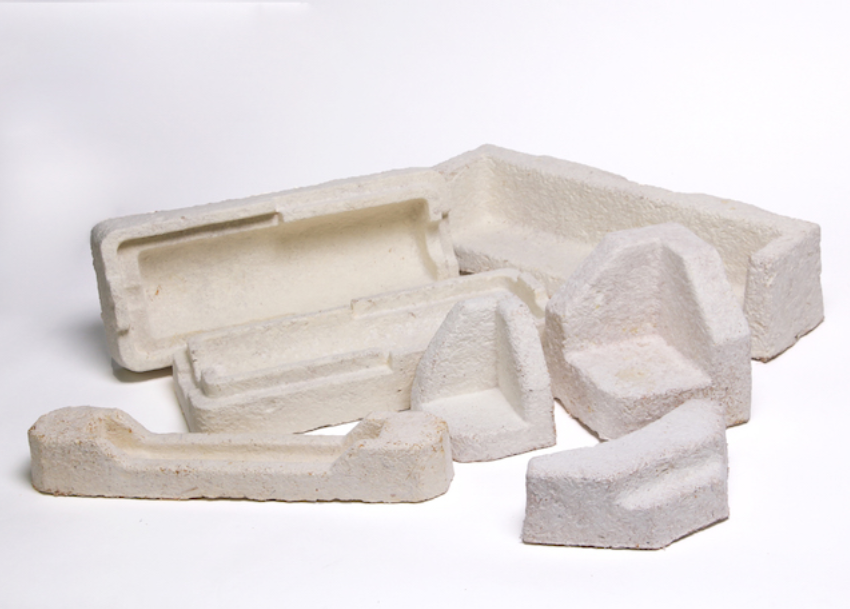
As an eco-friendly and innovative material, MycoMaterials a wide range of applications: thermal and acoustic insulation, packaging, bioremediation and filtration, design, and more.
The MycoMaterials are materials composed of raw materials that have been processed and fused with mushroom mycelium.
MycoMaterials a wide range of applications, which can be broadly categorized into three main groups:
- Insulation Panels: Provide excellent acoustic and thermal insulation, making them ideal for use in construction and architecture.
- Products and Packaging: These innovative designs can replace polystyrene in packaging, offering a biodegradable and eco-friendly alternative.
- Fungal Leather: A sustainable alternative to animal-derived leather, suitable for fashion and leather goods.
Physical Characteristics
MycoMaterials out for their unique appearance and texture:
- Appearance: Usually white in color, with a smooth surface.
- Texture: A soft, fluffy feel, reminiscent of the softness of certain fabrics.
- Renewable Resources: Made from renewable resources, unlike materials derived from the petrochemical industry.
- Less Energy and Emissions: Overall, production requires less energy and generates fewer greenhouse gas emissions.
- Biodegradability: 100% biodegradable, breaking down naturally without leaving behind toxic waste, ideal for packaging that replaces single-use plastics.
- Compostability: Can be composted, returning to the natural nutrient cycle.
- Thermal and Acoustic Insulation: Properties that make it ideal for manufacturing insulation panels, helping to reduce energy consumption in buildings.
- Natural Resistance: Mycelium makes substrates naturally resistant to water and fire.
- Insulation Panels
-
Eco-Friendly Packaging
Mycelium is used to create biodegradable alternatives to polystyrene and other synthetic packaging materials. This packaging can be designed to protect various products during transport, and it breaks down naturally after use.
-
Vegetable-tanned leather
Mycelium can be cultivated and processed to create a material similar to leather, often referred to as fungal leather. This plant-based leather is used in fashion and leather goods, offering a sustainable and ethical alternative to animal leather.
-
Furniture and Decor
Chairs, tables, and other interior design elements can be made from MycoMaterials, offering a unique design and a reduced environmental footprint.
-
Electronics and Automotive Components
MycoMaterials also being explored in the electronics and automotive industries for the manufacture of lightweight and durable components.
-
Textiles and Apparel
Some projects are experimenting with MycoMaterials create innovative textiles, offering an alternative to synthetic fabrics.
These panels are used in construction for thermal and acoustic insulation. They are lightweight, durable, and provide good insulation, while being fully biodegradable.
How are MycoMaterials produced MycoMaterials

The Different Steps The production of MycoMaterials to the first stage of conventional mushroom cultivation:
- Choosing the growing medium and variety
- pasteurization
- vaccination
- incubation
- molding
- drying
1) Choosing the growing medium and variety
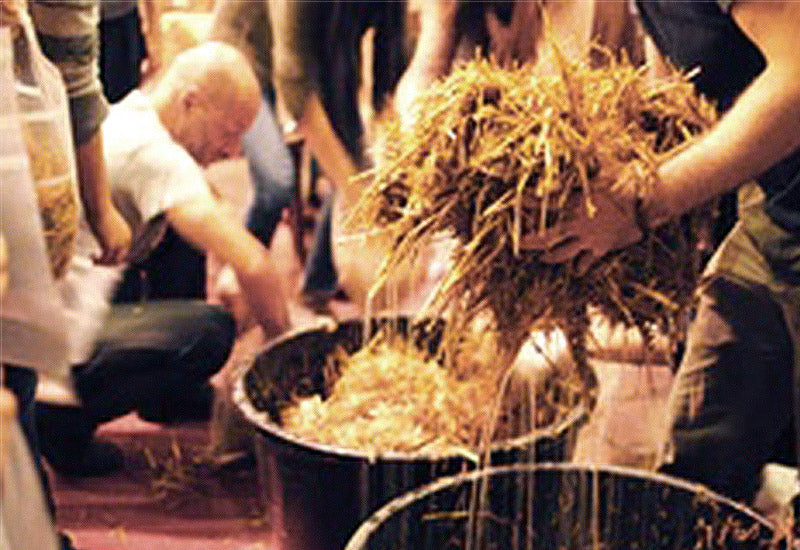
There are a wide variety of substrates that can be used: cereal straw, hemp fiber, wood chips, sawdust, cardboard, food industry waste, various textiles, coconut husks, etc.
Given the ecological approach that often accompanies projects involving mycomaterials, the substrates typically selected are also intended to repurpose waste from other activities and make use of local materials in order to reduce transportation and carbon footprint.
Beyond these environmental considerations, there are also technical factors to take into account in order to ultimately produce a high-quality product:
The species used for biomaterials are wood-decaying and saprophytic fungi: they naturally break down dead wood and, more generally, carbon-based materials.
A substrate that is too rich in nitrogen or sugar will be more conducive to bacterial growth, so you will have to work harder and devote more energy to sterilizing the substrate and ensuring the sterility of the inoculation and incubation processes.
Conversely, a substrate with a high carbon content is said to be “selective” because few microorganisms other than fungi can grow on wood chips.
However, a lack of nitrogen and sugars can result in a weak mycelium, slow and potentially incomplete colonization of the substrate, and consequently, a lower-quality yield.
➡️ Our tip: We generally use a carbon-based substrate such as straw or sawdust/wood shavings (preferably from hardwood trees) at a ratio of 80–90%, supplemented with a more nutrient-rich material such as grains, coffee grounds, hay, or similar at a ratio of 10–20%.
Mycelium is a living organism that needs oxygen to survive, colonize, and break down its substrates.
A substrate that is too dense or waterlogged will not allow it to breathe properly and will therefore be more conducive to anaerobic bacteria, for example. A substrate that is too dry will result in poor colonization of the substrate.
➡️ Our tip: We recommend a moisture content ranging from 60% for sawdust-based substrates to 70% for straw-based substrates.
Depending on the intended use, materials will require varying degrees of rigidity. For insulation panels, for example, a fibrous texture is preferred.
The choice of mycelium is, of course, important because some types are stronger than others. The mycelium acts as a binder, like glue that holds all the materials together. It is the fibers (crushed cereal straw, plant stems, burlap, etc.) that provide the strength.
Just as in building construction, we will “reinforce” the concrete: we will add metal structures to the concrete to make it stronger and more durable.
The fibers will also aerate the substrate, thereby improving its insulating properties. However, fibers that are too long will be impractical to use because they won’t fit properly into the molds, may puncture the bags, and could over-aerate the substrate.
➡️ Our tip: Use a mixture of chopped straw (ideally 1–3 cm) with 10–20% wood shavings (our optimal substrate works very well).


Choosing the variety:
- Reishi (Ganoderma lucidum)
- turkey tail (Tramaetes versicolor)
- the oyster mushroom (Pleurotus ostreatus)
Reishi and trametes belong to the “polypore” family of mushrooms: these are naturally very rigid mushrooms that can be found on tree trunks (both living and dead). These mycelia are very “aggressive,” meaning they quickly colonize a substrate and are highly competitive against other microorganisms. By adjusting the maturation times, these mycelia will also produce different colorations.
Reishi mycelium tends to be yellow, orange, and red. Trametes mycelium tends to be beige and dark brown.

Above is a bundle of reishi mushrooms just beginning to fruiting
Oyster mushroom mycelium is also commonly used. Like the two previous types of mycelium, it grows quickly and adapts to a wide variety of substrates. It is slightly less sturdy and dense than polypore mycelium, but it is one of the most widely used types of mycelium due to the cultivation of oyster mushrooms for food.
Yellow oyster mushrooms and pink oyster mushrooms can also be used for the visible coloration of their mycelium, which can produce interesting results from an artistic perspective. However, the mycelium of pink oyster mushrooms has a more delicate texture.
2) Pasteurization or sterilization
The purpose of this step is to eliminate most or all of the microorganisms originally present in the substrate, thereby clearing the way for the selected mycelium.
Insufficient pasteurization will generally result in “contamination”: typically, this will involve bacteria or mold colonizing all or part of the substrate, resulting in a product that falls significantly short of the expected quality—or, in some cases, is completely unusable.
There are various ways to pasteurize or sterilize a substrate, but that is not the focus of this article. To start with, we recommend two simple methods: pasteurization with lime or heat.

3) Inoculation, or seeding the substrate
After pasteurization and cooling to a temperature below 40°C, the substrate is mixed with the mycelium. We generally use grain-based mycelium is used because it allows for good dissemination of the mycelium throughout the substrate, as well as providing energy for the mycelium and thus faster colonization.
The inoculation rate may vary depending on the substrates used and the sterility of the techniques. Under optimal laboratory conditions, 1–2% mycelium should be used.
For a nutrient-poor substrate (i.e., higher in carbon) and non-sterile inoculation conditions, 5–10% mycelium should be applied to the substrate. A higher inoculation rate allows for faster colonization and thus reduces the risk of failure due to contamination by other microorganisms.
Containers:
Substrates are typically placed in perforated plastic bags or bags equipped with filters (our Unicorn bags, plastic sleeves, or buckets). The use of plastic at this stage serves several purposes: containing the substrate, maintaining a constant moisture level, and preventing contaminants (microorganisms and insects) from entering the substrate. Professional bags are equipped with a microfilter that allows oxygen to enter while preventing bacterial or mold spores from getting in.
On a small scale, and to reduce your carbon footprint, you can use reusable containers. Note, however, that these must be thoroughly cleaned to prevent recontamination of the substrates after pasteurization, and they must also allow the mycelium to breathe (for example, a bucket with a cotton plug).
4) Incubation
This is the stage during which the mycelium colonizes the substrate and breaks it down. For this stage, the mycelium needs warmth: the ideal temperature is between 20 and 25°C. Light has little effect at this stage, but it is generally recommended to keep the substrates in the dark. Once the substrate is colonized, you can move on to the next step.

5) Molding
Once the mycelium has fully colonized the substrate, it is placed in a mold, which will give it the desired shape. The substrate is broken up, crumbled, and distributed evenly. Depending on the project and objectives, molds can be created, for example, using a 3D printer, or for hobbyists using recycled items (vases, bottles, etc.). Although the substrate is already colonized by the mycelium, it is important to work cleanly and disinfect everything that comes into contact with the mycelium.
After being placed in the molds, the substrate is returned to incubation for 3 to 7 days to allow the mycelium fragments to fuse further and develop greater strength. During this phase, the mycelium still requires oxygen and constant humidity. Depending on the size of the molds, it is sometimes necessary to pierce them to improve airflow.
It is also possible to incubate the mycelium directly in its final mold after inoculation. However, it should be noted that breaking up and fragmenting the mycelium after the substrate has been colonized generally results in greater structural integrity later on.
Results may vary depending on the materials, the strain, temperatures, humidity level the air and in the substrate, incubation time, and other factors. Mushrooms are highly sensitive to their environment. It’s up to you to conduct your own experiments to better understand how mycelium works and identify the processes that best meet your needs.

6) Drying
Once the desired result is achieved, the substrate is dried to halt the activity of the mycelium and thus prevent it from continuing to break down the substrate and entering the fruiting stage. Drying can be done at low or high temperatures. It is important to note that the mycelium tends to retain moisture, which prolongs the drying time. Even if the outside appears dry, the inside of the object may remain damp, promoting the growth of small molds.
On a small scale, you can dry them outdoors on nice, sunny days or in the oven. When using the oven, set it to convection mode at a temperature below 80°C if possible. Alternate between 1 hour of heating and 1 hour of rest, opening the oven door regularly to let the moisture escape. The total drying time, which depends on various factors, generally ranges from 6 to 48 hours.
On a professional scale, the use of specialized drying ovens is recommended. It is essential to control both temperature and air circulation to ensure uniform and sufficiently rapid drying, thereby guaranteeing high-quality results.


We offer two options:
-
Easy Level:
Our ready-to-grow reishi logs. All you have to do is crumble it finely, place it in the mold of your choice, and then dry it after colonization. -
Intermediate level:
- We recommend reishi grain mycelium.
- Use our microfiber filter bags for incubation.
- And our straw pellets as a growing medium.
- Follow the steps outlined above.

It’s also a fun activity to do with kids. Success is guaranteed. It’s a great way for them to get acquainted with mycelium and the mysterious world of mushrooms. From there, you can discuss with them how mushrooms work, how they feed, and how they reproduce. It’s also an opportunity to explore topics related to ecology and the conservation of natural resources.
You can also choose our DIY Kit, which includes everything you need.
For more information:
- Growing Gourmet & Medicinal Mushrooms, by Paul Stamets.
- Mycelium Running, by Paul Stamets.
- Radical Mycology, Peter McCoy
- Compressive behavior of anisotropic mycelium-based composites (Rigobello & Ayres 2022).
Our Products for MycoMaterials


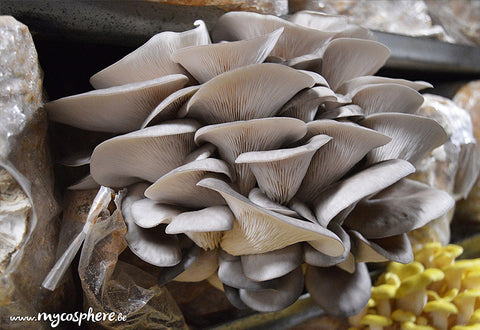
Organic Blue Oyster Mushroom Grain spawn
€13.90–€20.80
DIY Mushroom Kit
€10.50–€25.50
