Stropharia rugosoannulata, wine-red stropharia, king stropharia, or rough-ringed stropharia
How do you grow the wine-red stropharia in the garden?
The wine-red oyster mushroom is an excellent choice for beginners. Hardy, easy to cultivate, and well-suited to outdoor growing, it grows naturally on wood chips, straw, and garden mulch.
It is sometimes called the gardener’s mushroom because it thrives in organic vegetable gardens or permaculture systems. It prefers mulched areas, partially shaded spots, and living soils rich in microorganisms.
Its shelf life after harvest fairly short—often just 3 to 4 days—which explains why it is still rarely sold commercially. However, it is a tasty, meaty mushroom that is very interesting to grow at home.

What type of growing medium should I use?
The stropharia mushroom is generally grown on carbon-rich substrates:
- straw,
- wood shavings,
- coarse sawdust,
- old mulch or partially decomposed shredded material.
Hardwood shavings are generally the preferred choice. Softwood shavings can be used in small amounts, but it is best to avoid exceeding 25%.
You can also make a mixture:
- The straw quickly nourishes the mycelium,
- the chips serve as a long-term reserve,
- Sawdust helps fill in gaps and retain moisture.
Thick branches and logs are less suitable for oyster mushrooms. For this type of substrate, oyster mushrooms or shiitake mushrooms are a better choice.
The strophaire is a very hardy mushroom, capable of colonizing both fresh organic matter and material that has already been partially broken down by soil organisms. It therefore withstands microbial competition quite well, making it particularly suitable for outdoor cultivation.
Should the substrate be pasteurized?
When growing outdoors, pasteurization isn’t required, but it can improve the success rate, especially if you’re using old straw or wood chips, or if you want to give the mycelium an extra boost.

There are two simple options:
Option 1: Soaking in lime water
Soak the straw or wood chips overnight in clean water. You can add about 1 cup of lime per 50 liters of water. This helps to:
- thoroughly moisten the growing medium,
- clean it partially,
- make it more alkaline,
- limit the growth of certain molds and bacteria.
Option 2: Extended pre-moistening of the chips
Wood chips can also be soaked for 1 to 2 weeks before use. This helps to thoroughly hydrate them, kickstart their biological decomposition, and make them more hospitable for the stropharia.
In any case, we recommend using the freshest materials possible and moistening them thoroughly before sowing.
How deep should it be?
A substrate layer 15 to 20 cm thick is generally ideal. A deeper bed can produce mushrooms for a longer period, but it will often take longer to yield the first mushrooms.
Where should it be located?

Like most mushrooms, the stropharia prefers indirect light and partially shaded areas. It can tolerate a few hours of sunlight a day, but it does not do well in dry conditions.
It's best to choose a spot that naturally stays a little cool and damp.
Examples of suitable locations:
- at the base of fruit trees,
- along a hedge or forest edge,
- on a path lined with wood chips,
- when mulching cover crops such as squash or potatoes.
When will I be able to harvest?
The stropharia mushroom can fruit from spring through fall, generally at temperatures between 10 and 22 °C.
The first mushrooms often appear 2 to 4 months after inoculation, depending on the season, humidity, and the thickness of the substrate.
Once it is properly established, it can continue to produce for 2 to 3 years, especially if you regularly add new carbon-rich material.
How much mycelium is needed for a given area?
We generally recommend using 5 to 10% mycelium relative to the weight of the moist substrate.
Example: An 8-kg bale of dry straw weighs approximately 25 to 30 kg once thoroughly moistened. A 3-kg bag of mycelium is then sufficient to inoculate approximately 3 to 6 square meters of straw mulch, depending on the dosage chosen.
For faster and more reliable colonization, especially for beginners, it is best to aim for a concentration of around 10%.
Maintenance
Once it is well established, the stropharia requires little maintenance. The most important thing is to avoid prolonged drying out.
- Water during dry periods, without letting the soil become waterlogged.
- If possible, keep a light covering in place: cardboard, shade cloth, a thin layer of soil, or fresh mulch.
- Add some fresh wood shavings or a little straw every now and then to extend the life of the bedding.
The stropharium may sometimes reappear several meters away from where it was originally formed. This is a common occurrence when the mycelium spreads through mulch or soil.
You can also take a portion of the well-developed mycelium to inoculate another area. In this case, use about 20% mycelium relative to the new moist substrate.
The best times for sowing
Spring andfall are the best times of year.
Planting in the spring can yield a first harvest summer, and sometimes a second one in the fall. After that, the garden bed can continue to produce for several seasons, depending on the materials used and the moisture level.
How do I do that?
Choose your bedding material (straw, wood shavings, sawdust, or a mixture)—as fresh as possible—and then choose the method that works best for you.
-
The Strophaire Bed

This is the method we recommend most. It’s simple, reliable, and works very well in most gardens.
- Roughly clear the ground. You can also dig a small trench to help retain moisture.
- You may want to add a layer of cardboard at the bottom to keep weeds down.
- Spread a first layer of moist substrate 5 to 10 cm thick.
- Crumble the mycelium and spread it evenly over the entire surface.
- Cover with a new layer of substrate.
- Water generously, using about 10 liters of water per square meter.
- If the area is dry, add a thin layer of soil, cardboard, shade cloth, or a lightweight tarp.
In a greenhouse, a drip irrigation system can be very useful for maintaining humidity.
-
The “straw bale” method
This method is very simple, but a bit riskier because the core of the bundle can either dry out or, conversely, become too damp.
- Moisten the bale of straw by soaking it overnight, or by watering it several times a day for 2 to 3 days.
- Next, place small handfuls of mycelium in various spots inside the bale.
- Place the bundle in the shade and cover it partially with a lightweight tarp, shade cloth, or a little soil to prevent it from drying out.
The right balance is important: the bale should remain moist but well-ventilated, never soggy.
-
Growing in pots

This method is ideal for a patio, balcony, or small space. Choose pots that are about 20 to 40 cm in diameter and height, and make sure they are clean and well-washed.
- Soak clean straw in water overnight. You can add lime to improve the substrate preparation.
- Mix the damp straw with the mycelium at a rate of 5 to 10% of the wet weight.
- Fill the pots, leaving about 5 cm of space at the top.
- Lightly tamp it down, without packing it too tightly.
- Cover the top while the plants are taking root to prevent them from drying out.
- After 2 to 3 weeks, add a layer of mulch: potting soil, or a mixture of soil, sand, and peat.
- Keep moist. Mushrooms may appear 2 to 3 weeks later.
Identification
The wine-red stropharium is a mushroom that is relatively easy to identify, but as with all mushrooms, its appearance can vary depending on humidity, age, and growing conditions.
If you have any doubts, do not consume it and ask a qualified person for confirmation.
- Cap: often wine-red to reddish-brown when young, then lighter with age; generally between 5 and 10 cm, sometimes up to 20 cm.
- Gills: initially light in color, then darkening as the spores mature.
- Stem: sturdy, with a clearly visible ring, often marked and rough.
- Flesh: white, firm, and thick.
- Spore: dark purplish brown.
For a more detailed description, please visit the relevant Wikipedia page:
Stropharia rugosoannulata on Wikipedia
What is the mycelium bag made of?
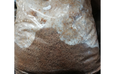
We provide the mycelium on a mixture of sawdust, straw, and grains. This allows the mycelium to have already encountered and broken down several types of materials that it will later encounter in the garden.
This mixture promotes faster colonization of the new substrate. The grains also give the mycelium a good start and boost its vigor during the colonization phase.

Buy organic wine-red stropharia mycelium
All of our products are certified organic under the "BE-BIO-01" standard.

Our mycelia are produced under laboratory conditions, ensuring varietal purity and optimal quality.
Production time: 2 to 4 weeks. If the product is in stock, we usually ship it within a week.

About the author
He has been working for several years on mycelium cultivation, organic mushrooms, and functional extracts. Through his articles, he shares practical expertise gained from the production, experimentation, and processing of mushrooms.
Discover the Mycosphere