How do you choose a high-quality Lion’s Mane extract?
Lion’s Mane, or Hericium erinaceus, is now available in many forms: powder, capsules, tinctures, liquid extracts, or mycelium-based products. But not all of these products are created equal. To make the right choice, you need to look beyond marketing claims and understand what the product actually contains.
A high-quality Lion’s Mane extract should clearly state which part of the mushroom is used, the actual amount of raw material, the extraction process, and the level of traceability. This information allows you to compare products more objectively and choose a formula that is truly transparent.

In summary
Before buying a Lion’s Mane extract, be sure to check:
- if the product uses fruiting, mycelium, or a mixture of both;
- if the quantity of mushrooms is clearly stated, for example as a dry matter equivalent;
- if the extraction process is explained;
- if the manufacturer provides information about the origin, quality, and inspections;
- if the figures shown are understandable and put into context.
Key criteria for making the right choice
1. The part used
Does the product specify whether it contains the fruiting body, the mycelium, or both? This information is essential for understanding what you are buying.
2. The actual quantity
A 30-ml bottle doesn't tell you how much mushroom was actually used. The dried mushroom equivalent is often more informative.
3. The type of extraction
Hot water, alcohol, CO₂, ultrasound: each method is used to process different parts of the mushroom.
4. Transparency
Origin, organic certification, quality controls, and traceability are key factors in assessing the reliability of an extract.
1. fruiting, mycelium, or a mixture: what should you look for?
Lion’s Mane consists of several parts. The fruiting is the visible mushroom, the part that is harvest. The mycelium is the filamentous network that grows within the substrate.
These two parts are not identical. They may contain different families of compounds with complementary profiles. This does not mean that one part is automatically better than the other, but it does mean that the label must be clear.

Some products simply list “Lion’s Mane” without specifying whether it is the mushroom, the mycelium, or a blend. Others use mycelium grown on grains, which can make the final composition harder to interpret if the growth medium is not clearly distinguished from the finished product.
The part used must be clearly indicated. A transparent product specifies whether it contains fruiting bodies, mycelium, or both.
2. Is the amount of mushrooms used clear?
The volume of the bottle or the weight of the box is not enough to determine the concentration of an extract. Two bottles of the same size may contain very different amounts of Lion’s Mane.
The most useful information is that which clearly statesthe dry mushroom equivalent, the amount per serving, or the analyzed compounds when such data is available. A statement such as “25,000 mg of dried Lion’s Mane per bottle” is more informative than a vague phrase likeconcentrated extract without further details.
3. Why does the extraction process matter?
A mushroom contains various types of molecules. Some dissolve better in hot water, while others require different conditions. This is why the extraction process plays a key role in the final quality of the product.
Simply using dried mushroom powder is not the same as using an extract. Conversely, an extract isn’t automatically better unless its properties are clearly explained. Ideally, the manufacturer should specify the type of extraction method used and the rationale behind that choice.
4. Should we rely on ratios like 10:1?
Extraction ratios can be useful, but they are not enough to judge a product’s quality. A high ratio alone does not guarantee better quality. It all depends on the raw material, the part used, the extraction process, and what is actually being concentrated.
A product may list "10:1" without explaining which part of the mushroom was used or which compounds it targets. It is therefore better to prioritize comprehensive information rather than a single impressive but isolated number.
5. Compare the main varieties of Lion’s Mane
| Format | Benefits | Things to check |
|---|---|---|
| Mushroom powder | A simple, minimally processed product that closely resembles the raw ingredient. | Amount to be consumed, fineness of grind, digestibility, absence of extraction. |
| Capsules | Convenient, easy to measure, and easy to carry. | Exact composition, excipients, actual amount per dose, part used. |
| Simple dyeing | Easy to take, convenient liquid form. | Actual concentration, any residual alcohol, amount of mushroom used. |
| liquid extract | Clear dosage, easy to take, and the ability to process multiple parts of the mushroom. | Extraction process, dry mushroom equivalent, traceability, and quality controls. |
Common mistakes to avoid
Confusing the product's weight with the amount of mushrooms
A 30-ml bottle or a 60-g box alone does not indicate the amount of Lion’s Mane used. You need to look at the raw material used or the measured compounds.
Buying a product that does not specify which part is used
The term “Lion’s Mane” is too vague unless it is accompanied by information about the fruiting body, mycelium, or blend used.
Relying solely on an extraction ratio
A ratio may be useful, but it must be accompanied by other information: the portion used, the process, the source, the controls, and the actual concentration.
Believing overly general promises
A high-quality extract should win people over with its composition, transparency, and traceability—not with vague or sensational promises.
Our Approach at Mycosphere
At Mycosphere, we take a straightforward approach: we offer products that are easy to understand, traceable, and consistent with our expertise as growers and processors of organic mushrooms.

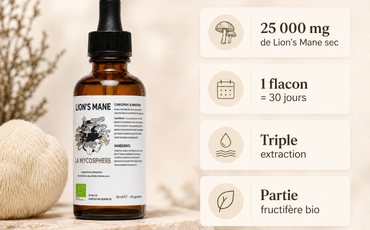
Our organicliquid extract is made exclusively from the fruiting body, without any mycelium grown on grains. Each 30-ml bottle contains the equivalent of 25,000 mg of dried Lion’s Mane.
We use a triple extraction process combining CO₂, ethanol, and ultrasonic-assisted hot water to process different fractions of the mushroom. The extract is then formulated into a gentle glycerin-based base that is pleasant to use on a daily basis.
Our goal is not to make a lot of promises, but to provide customers with clear information: which part of the mushroom is used, how much mushroom is included, and how the extract is made.
Organic Lion’s Mane Extract by Mycosphere
A liquid extract made from the fruiting body of Lion’s Mane, featuring a triple extraction process and 25,000 mg of dried mushroom per 30-ml bottle.
Explore the extractHow can you tell if a Lion’s Mane extract is high-quality?
Before you buy, ask yourself these five questions:
- Is the part being used clearly indicated?
- Is the actual amount of Lion’s Mane clear?
- Is the extraction process explained?
- Are the figures being presented in context?
- Is the manufacturer transparent about the origin, quality, and quality controls?
If the answer to these questions is yes, you are already dealing with a product that is much easier to evaluate seriously.
FAQ
What is the difference between Lion’s Mane powder and extract?
The powder contains dried, ground mushroom. An extract is designed to concentrate certain components of the mushroom through an extraction process. Both forms can be beneficial, but they are not directly comparable when taken in equal amounts.
Should you choose fruiting bodies fruiting mycelium?
It depends on the product and its transparency. The fruiting bodies fruiting mycelium may have different profiles. The important thing is that the part used is clearly indicated and that the product is easy to assess.
What doesconcentrated extract mean?
This label typically means that some of the mushroom’s components have been extracted and concentrated. However, it remains too vague unless accompanied by information about the raw material, the amount used, and the extraction process.
Is the extraction ratio sufficient to judge quality?
No. A ratio can be useful, but it does not replace information about the part used, the process, traceability, and quality controls.
Why do some extracts use multiple extraction methods?
This is because the various compounds in the mushroom do not all dissolve under the same conditions. Combining several methods allows us to work with multiple fractions of the mushroom rather than just one.
For further reading
You can discover our organicliquid extract , visit our “Our Commitment” page, or learn more about the Mycosphere project.

About the author
He has been working for several years on mycelium cultivation, organic mushrooms, and functional extracts. Through his articles, he shares practical expertise gained from the production, experimentation, and processing of mushrooms.
Discover the Mycosphere