

Disclaimer: This guide is intended for growers who wish to cultivate edible or medicinal mushrooms at home. The practices described should always be adapted to the species being grown and the applicable legal framework.
1. Introduction
The substrate is the foundation of a successful mushroom cultivation. It nourishes, hydrates, and supports the mycelium until fruiting. A poorly chosen or poorly prepared substrate can jeopardize an entire crop, even with the best spores or mycelium.
Some edible and medicinal mushrooms have specific substrate requirements. Certain species, such as oyster mushrooms or spear mushrooms, grow naturally in meadows rich in organic matter or manure. Growers therefore strive to replicate these growing conditions as closely as possible in a controlled environment.
Among the simplest and most effective solutions, the CVG substrate (coconut coir, vermiculite, and gypsum) has established itself as the go-to choice for both novice and experienced growers. Easy to prepare, economical, and highly effective, it is ideal for growing many species of mushrooms at home, including oyster mushrooms, piopino mushrooms, and other medicinal or edible mushrooms.
In this article, we offer a comprehensive and practical guide: you’ll gain a deep understanding of what CVG substrate is, why it works so well, and, most importantly, how to easily make it using the right materials. Ready to give your mycelium the best chance of success? Let’s get started!
2. What is the CVG substrate?
CVG substrate is one of the most commonly used mixtures for indoor mushroom cultivation. Its name comes from its three main ingredients: coconut coir, vermiculite, and gypsum. Together, these materials create an ideal environment for the mycelium to colonize quickly and produce high-quality fruiting bodies.
Coconut fiber: an ideal substrate for mycelium

Coco coir, or coconut fiber, is derived from the husk of coconuts. It effectively retains moisture while remaining light and airy—two essential factors for mycelium growth. Using a coconut fiber substrate provides a stable structure that resists compaction and is naturally resistant to contaminants.
Vermiculite: for better water and air retention

Vermiculite is an expanded mineral that plays a key role in maintaining the balance of the growing medium. It improves water retention without making the mix soggy, and also promotes good air circulation. A coconut-vermiculite growing medium thus provides an environment that is both moist and well-oxygenated—perfect conditions for stimulating mycelium growth.
Gypsum: to enrich and stabilize the growing medium

The Gypsum (calcium sulfate) is often added in small amounts to stabilize the substrate’s pH and prevent it from becoming too acidic over time. It also provides calcium and sulfur, two nutrients that promote mycelium health. In a mycelium substrate, gypsum contributes quietly but effectively to more abundant harvests.
3. Why choose a CVG substrate?
CVG substrate has established itself as a reliable choice for mushroom growers, whether they are beginners or more experienced enthusiasts. Here’s why this simple mix remains a strategic choice for successful cultivation.
Excellent water retention capacity
Thanks to coconut fiber and vermiculite, the CVG growing medium maintains an ideal moisture level for mycelium growth without becoming waterlogged. This moisture stability reduces the risk of drying out or overwatering, two common causes of failure in home mushroom cultivation.
A low contamination rate
Unlike other growing media that are richer in organic matter (such as manure or straw), coconut coir growing media provides little nourishment for unwanted bacteria. This makes it a cleaner, more stable medium that is easier to sanitize through simple pasteurization. CVG is therefore an excellent choice for those who want to avoid contamination.
High adaptability
The CVG substrate is suitable for a wide variety of mushrooms: oyster mushrooms, psilocybe mushrooms, reishi, lion’s mane, etc. It can be used as is or enriched to meet the specific needs of a particular species. It is a versatile, reliable substrate that can be customized as needed. However, it is generally used more for saprophytic mushrooms (those that grow on manure or near cow or horse droppings, for example) than for xylophagous mushrooms (which decompose wood).
Quick and easy to prepare
No need for complicated equipment or lengthy composting steps: CVG is easy to make with readily available ingredients. A good block of coconut fiber, vermiculite, a little gypsum, warm water… and you’ll have a high-quality growing medium, ready for planting.
High-quality ingredients = high-quality farming
The success of a CVG growing medium also depends on the quality of the materials used. Clean, well-fluffed coconut fiber free of contaminants is essential. With this in mind, the Mycosphere Coconut Fiber Block was designed: a reliable, practical product perfectly suited for mushroom cultivation.
4. Product Spotlight: Mycosphere Coconut Fiber 🌱
To produce a high-quality CVG growing medium, the choice of ingredients is crucial, and it all starts with high-quality coconut coir. That’s why Mycosphere coconut coir is particularly well-suited for discerning growers.
Our coconut fiber block is 100% natural, free from chemical treatments and additives. This ensures a clean, healthy, and mycelium-friendly growing medium, with no risk of unwanted residues.
Easy to handle, the compressed block is compact, lightweight, and easy to store, even in a small space. Simply rehydrate it to obtain an airy, fluffy, and perfectly textured coconut fiber—ideal for preparing a balanced coconut-vermiculite growing medium.
Whether you're a beginner or an experienced grower, the Mycosphere Coconut Fiber Block provides a reliable foundation to get your plants off to the best possible start.
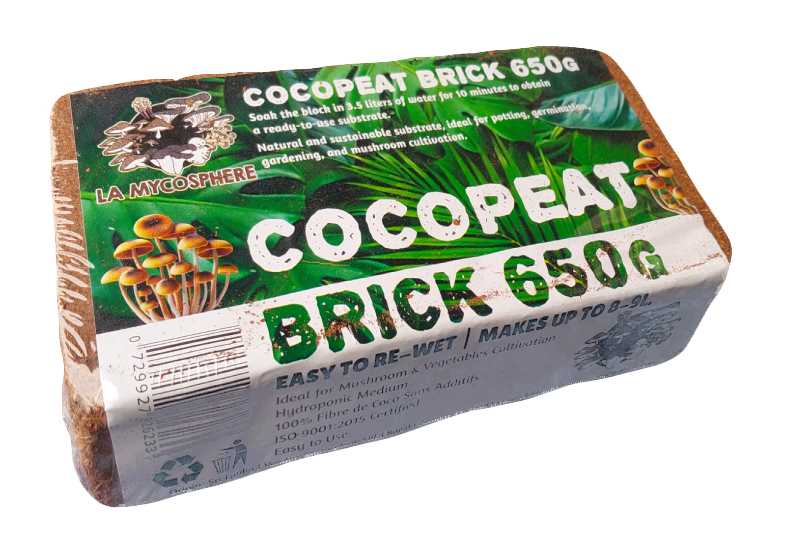
The perfect coconut fiber block for your CVG growing medium!
Our 100% natural coconut fiber is perfect for creating a high-performance growing medium. Untreated and easy to store thanks to its compressed form, it provides an optimal texture once rehydrated.
Learn more about the product5. How to Prepare Your CVG Substrate? (Step-by-Step Guide)
Making your own CVG substrate is simple and rewarding. Here’s a clear step-by-step guide to ensure success every time.
Materials needed
-
1 block of compressed coconut fiber (such as the Mycosphere Block)
-
2 liters of medium- or fine-grade vermiculite
-
50 g of gypsum (optional but recommended)
-
Hot water (not boiling)
-
A large, clean container
-
A spoon or a spatula for stirring
-
Clean gloves (optional)
Preparation steps
1. Moisten the coconut fiber block

Place the ingredients in a bucket, pour in the boiling water, seal tightly, and let sit. You can also cover the bucket with a blanket to extend the pasteurization time. Always wear protective glovesto avoid burns during this process.
Work in a clean area. After 6 to 8 hours of cooling, stir vigorously to ensure the mixture is uniform.
A quick tip: Be sure to break up the coconut fiber thoroughly with your hands to prevent the formation of "lumps," which would hinder colonization.
2. Add the vermiculite and gypsum
Once the coconut coir is thoroughly moistened and aerated, add the vermiculite and gypsum.
Tip: Lightly sift the vermiculite if it contains large clumps to achieve a more uniform texture.
3. Mix thoroughly
Mix everything together by hand (wearing clean gloves) or using a shovel.
The goal is to ensure that the vermiculite and gypsum are evenly distributed throughout the coconut coir.
A quick reminder: a uniform mixture ensures better colonization of the substrate by the mycelium.

4. Adjust the moisture content ("squeeze test")
Take a handful of the mixture and squeeze it tightly in your hand:
-
If a few drops of water roll off your fingers, that’s perfect.
-
If water drains freely, the soil is too wet: add a little dry coconut fiber or vermiculite.
-
If nothing comes out and the mixture is crumbly, add a little water.
Tip: Use a misting spray or a gentle spray to finely adjust the humidity without soaking the growing medium.

A growing medium composed of a mixture of hydrated coconut fiber, grains, and gypsum, just before being sterilized in a pressure cooker. The addition of grains increases the nutrient content of the medium—and thus its potential productivity—but it also raises the risk of contamination, as bacteria are also attracted to the sugars present in the grains.
6. Pro Tips for an Even Better CVG Substrate
Even though the CVG growing medium is easy to prepare, a few tips from experienced growers can really make a difference. Here’s how to maximize your chances of success.
Always check for moisture using the "squeeze test"
Substrate moisture is one of the most critical factors. After mixing your CVG, always perform the "squeeze test":
-
Squeeze a handful of potting mix in your hand.
-
A few drops should roll off without running down.
If it’s too damp, the mycelium may suffocate or give way to contaminants.
If it’s too dry, the mycelium will have trouble colonizing the substrate.
👉 Take your time adjusting the humidity. This small effort at the start can make all the difference!
Don't pack the substrate too tightly
When packing the substrate into bags or containers, it is important not to pack the CVG substrate too tightly.
The mycelium needs oxygen to breathe and grow. If the substrate is too dense, this slows down colonization and increases the risk of rot.
Tip: Gently tap the potting mix so that it conforms to the shape of the container, without ever forcing or compacting it.
Is gypsum always necessary?
Plaster is very useful, but not essential in every situation:
-
Use this if you want to stabilize the pH in long-term cultures (Reishi, etc.) or enrich your substrate with calcium.
-
You can skip this step for fast-growing crops such as certain oyster mushrooms or psilocybe mushrooms.
👉 If in doubt, adding a little gypsum is often a safe bet.
Adjust the CVG according to the crop being grown
Every type of mushroom has its own little preferences:
-
Oyster mushrooms: prefer a slightly more aerated and lighter substrate (add a little more vermiculite to lighten the texture).
-
Coprophilous medicinal mushrooms: thrive in the classic structure of a standard CVG.
-
Wood-decaying mushrooms ( Reishi, Lion’s Mane): thrive in a slightly moister substrate, sometimes enriched with additional nutrients, typically made from sawdust.
Tip: By carefully adjusting the texture and moisture content to suit the specific crop, you can achieve faster and more abundant harvests.
Can you enrich your CVG substrate?
Although the standard CVG substrate is already very effective, it can be enriched to produce more abundant harvests, particularly with certain high-nutrient-demand species.
Enrich with sterilized grains
Adding sterilized grains (such as rye, wheat, or millet) to the CVG substrate provides additional nutrients rich in sugars and nitrogen. This stimulates the rate of colonization and can improve production.
Caution: An enriched substrate is also more attractive to contaminants (bacteria, mold). It is therefore essential to handle the grains under ultra-clean conditions and ensure thorough sterilization.
Apply pelletized manure
Composted and pasteurized pelletized manure (horse, poultry, etc.) can be added in small amounts to enrich the growing medium. It improves nutrient content without making the texture too heavy, provided it does not exceed 5 to 10% of the total volume, as pelletized manure is often highly concentrated.
Tip: Choose pasteurized pellets of horticultural quality to minimize risks.
Enrich with coffee grounds
Coffee grounds can be used to enrich the substrate with nitrogen, which generally promotes more vigorous mycelial growth and more abundant yields. They can improve the nutrient composition of the substrate and support the development of many saprophytic species.
It is recommended to mix in approximately 10 to 20 percent of the total volume of the growing medium.
However, please note: coffee grounds are highly susceptible to contamination.
They must be used fresh (ideally within 24 hours of extraction) if stored at room temperature, as they quickly become colonized by mold and bacteria.
To minimize risks:
-
use fresh coffee grounds,
-
work neatly,
-
or store it in the freezer until you have enough to prepare your growing medium.
Once thawed, use it immediately and do not refreeze it.
A tip for beginners
If you're just starting out, it's recommended that you don't enrich your CVG growing medium. A simple growing medium is more stable, less risky, and much more forgiving if you make mistakes.
You might harvest a little less, but you'll maximize your chances of success and satisfaction by avoiding the risk of losing everything due to contamination.
7. Quick FAQ
Do I need to pasteurize my CVG?
Yes, it is strongly recommended that you pasteurize your CVG substrate, especially if you are working in a non-sterile environment. This reduces the risk of contamination and gives the mycelium a head start.
What is the best coconut fiber for making coconut oil?
A 100% natural coconut fiber that is chemical-free and well-loosened is ideal. The Mycosphere Coconut Fiber Block is specially designed for this purpose.
Can vermiculite be replaced with something else?
Vermiculite is hard to replace because it combines water retention with aeration. As an alternative, you could try perlite, but the results will often be less than ideal for mushroom cultivation.
Is gypsum really necessary?
Gypsum is not required, but it helps stabilize the pH and provides nutrients that are beneficial to the mycelium. It is particularly recommended for long-term grows or enriched substrates.
How long can I keep my prepared CVG?
CVG substrate can be stored for 1 to 2 weeks in a clean, airtight bag in a cool place. It is important to check that it does not dry out or develop any unusual odors before use.
8. Conclusion
CVG substrate is a simple, reliable, and effective solution for successfully growing mushrooms at home. Thanks to its water-retention capacity, low risk of contamination, and high adaptability, it has become the go-to choice for both novice and experienced growers.
The perfect coconut fiber block for your CVG growing medium!
Our 100% natural coconut fiber is perfect for creating a high-performance growing medium. Untreated and easy to store thanks to its compressed form, it provides an optimal texture once rehydrated.
Order the product


