The Blue Foot: A Majestic Mushroom of the Cold Seasons
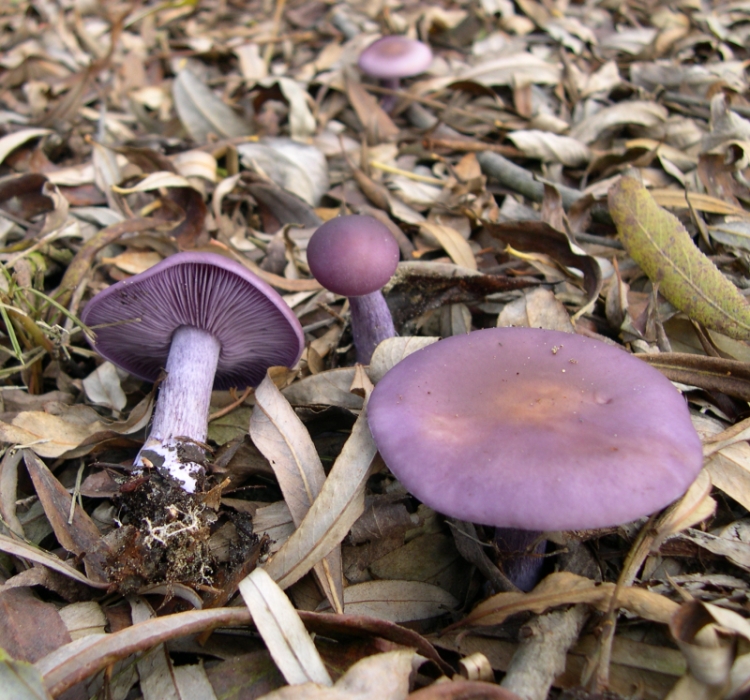
The Blue Foot, or Lepista nuda, is a remarkable mushroom, recognizable by its lilac to violet hues. This mushroom appears mainly during the fall and winter months, taking advantage of the first frosts to begin fruiting.

Table of Contents:
1) The Blue Foot: A Mushroom with Many Names
Belonging to the Clitocybe genus, the Blue-stalked Mushroom is known by several common names: naked agaric, blavoun, naked tricholoma, or naked rhodopaxillus. Historically, it was classified under the names Tricholoma nudum and Rhodopaxillus nudus before being officially recognized by its current name, Lepista nuda.
Hat
Conical in shape when young, the cap of the Blue Foot measures between 5 and 15 cm in diameter. As it ages, its edges spread out, and its surface, which is initially smooth and purple, turns a dirty brown. This cap is slightly hygrophanous, meaning that its appearance changes depending on the humidity in the air.
Blades
The thin, closely packed leaves are a deep purple when young. As they age, they gradually take on brown or ochre hues and easily separate from one another.
Foot
The stem is cylindrical, relatively bulbous at the base, fleshy, and fibrous. It is a deep purple color and is streaked with whitish fibers, giving it a distinctive striated appearance.
Flesh
The flesh of the Blue Foot mushroom is tender, thick in the cap, and more fibrous in the stem. Initially purple, it turns lilac over time. It has a pleasant fruity aroma, and its flavor is mild, sometimes with a slight tang.

2) The Ecology of the Bluefoot: A Child of the Forests
The Blue Foot mushroom grows primarily in deciduous and coniferous forests, preferring soils rich in organic matter such as fallen leaves and pine needles. This mushroom is unique in that it grows in "witch's circles," a natural formation where mushrooms grow in a circle. It appears at the beginning of winter, usually after the first cold snap or frost.
A Versatile Mushroom and Natural Recycler
The Blue Foot mushroom is also notable for its ability to break down organic matter. It thrives in soils rich in organic debris, whether in forests, gardens, meadows, orchards, or compost piles. However, it is important to note that this mushroom does not grow well on compost that is too mature. It prefers fresh, minimally decomposed substrates, such as composted straw, plant matter, or composted leaves. For optimal growth, the ideal substrate should consist of both fine and coarse materials, creating a well-aerated matrix that promotes mycelium growth.
3) Nutritional Value and Medicinal Properties
In addition to being delicious, the Pied Bleu has interesting nutritional and medicinal properties. Rich in vitamin B, it also possesses antibacterial and antifungal properties. However, it is crucial to eat it thoroughly cooked, as when raw, it contains hemolysins—molecules that can attack red blood cells. When properly prepared, the Pied Bleu retains a crisp texture and an exquisite flavor.
Source: Wikipedia
4) Growing Bluefoot: A Process to Master

The cultivation of the Blue Foot mushroom follows methods similar to those used for button mushrooms. Production generally peaks between August and November, following a period of frost and cold weather. To ensure fruiting the fall, it is essential to plant the mycelium in early spring. If this is not done, the mushroom will not fruit until the following summer.
What You'll Need
- Mycelium: A 3-kilogram bag of mycelium can cover an area measuring 1.5 meters by 1.5 meters.
- Substrate:Approximately 1/4 to 1/2 cubic meter, equivalent to a 9-square-meter area with a depth of 10 centimeters. Use composted hardwood chips and composted manure/straw.
- Cardboard free of dyes containing heavy metals.
Cultivation Methods
Method 1: Outdoor Growing
- Preparing the growing bed: Dig a bed of soil 20 to 25 cm deep. Fill it with compost made from various organic materials, then add the mycelium to the top 10 cm. Finally, add the topsoil as described above.
- Planting and watering: Add 7–8 centimeters of growing medium, mixing in a generous amount of mycelium. Firm the surface to remove air pockets and water lightly.
- Monitoring growth: Mycelium colonization should take between 6 and 12 months, depending on the weather and when the spawn is inoculated. It is recommended that you set up your growing bins in the spring for fruiting the fall.
Method 2: Container Gardening (Indoors)
Although Lepista nuda is usually grown outdoors, it can also be grown indoors thanks to research conducted by INRA, which has led to the development of more commercially viable techniques since the 2000s.
- Preparing the growing medium: Soak the growing medium for 2 days to ensure it is thoroughly moist, then drain it.
- Potting: Fill the pots with potting mix, leaving 5 centimeters at the top for the topdressing layer. Keep out of direct sunlight.
- fruiting Once the substrate has been colonized, cover it with the top-up medium. A cold shock is necessary to trigger fruiting. Adding certain nematodes can also stimulate fruiting mimicking natural conditions.
Recipes for Capping Mix
To encourage fruiting blue-footed mushrooms, it is recommended to use a substrate mix, which can be prepared in several ways:
- Sphagnum moss potting mix: Mix 1.3 kg of dry sphagnum moss with 3 liters of water and add 2 tablespoons of slaked lime.
- Balanced potting mix: Use a potting mix with a balanced pH, mixed with mature compost rich in microorganisms.
- Garden soil: As a last resort, you can also use soil from your garden for backfilling.

5) Recipe: Blue-Footed Gratin
Here’s a delicious way to cook blue mussels:
- Ingredients:
- 500 g of blue mussels, cleaned and sliced
- 3 medium potatoes, peeled and thinly sliced
- 1 onion, finely chopped
- 2 cloves of garlic, minced
- 200 ml of crème fraîche
- 100 g grated cheese (Parmesan or Gruyère)
- 50 g butter
- Salt, pepper, and nutmeg to taste
- Fresh parsley for garnish
- Method:
- Preheat the oven to 180°C.
- Sauté the onions and garlic in butter until golden brown. Add the blue mussels and sauté until tender.
- In a baking dish, arrange a layer of potatoes, add some of the sautéed mushrooms, then repeat the process until all the ingredients are used up.
- Pour the crème fraîche over everything, then season with salt, pepper, and a pinch of nutmeg.
- Sprinkle with grated cheese and bake for about 45 minutes, or until the gratin is golden brown and the potatoes are fully cooked.
- Garnish with fresh parsley and serve hot.

About the author
He has been working for several years on mycelium cultivation, organic mushrooms, and functional extracts. Through his articles, he shares practical expertise gained from the production, experimentation, and processing of mushrooms.
Discover the Mycosphere