An Introduction to the Fascinating World of Mushrooms
Mushrooms play a crucial role in our ecosystems, helping to break down organic matter and recycle essential nutrients. They are also ubiquitous in our diet and culture.
However, technical jargon can sometimes make this field difficult to understand. That’s why we’ve created this glossary to help you better understand the most common terms in the world of mushrooms.
Glossary of Key Terms
A device used to sterilize substrates in mushroom cultivation by using pressurized steam to eliminate all microorganisms.
Fungal mycelium, consisting of a network of small white filaments. It is used as a spawn, on a base of grains or sawdust.
The sporophore, or fruiting body, is the visible part of a mushroom, often referred to simply as a "mushroom" in everyday language.
A term referring both to the kingdom Fungi and, in everyday language, to the fruiting mycelium, which appears as a stem and a cap.
A group of mycelial cells from the same source that fuse to form a single body when they come into contact with one another.
Asexual reproduction of mycelium, similar to taking cuttings from plants, which allows a fungus to be propagated with the same genetic characteristics.
The reproductive part of the fungus, corresponding to the sporophore.
The kingdom of fungi, distinct from plants and animals, comprising yeasts, molds, and higher fungi.
Microscopic filaments that make up the fungus's mycelium.
Organisms that obtain their organic matter by feeding on other organisms. Fungi are heterotrophs.
The stage during which the mycelium colonizes the substrate, taking anywhere from a few weeks to several months depending on the species of fungus.
The process of inoculating a substrate with mycelium, typically after the substrate has been pasteurized.
A laminar flow hood used to create a sterile environment during inoculation or the preparation of mycelium.
Synonymous with inoculation, a term used to describe the process of inoculating a substrate with mycelium.
A symbiotic relationship between at least one fungus, one type of algae, and a bacterial community. Lichens are found in often hostile environments.
An organic compound found in wood that is broken down by certain saprophytic fungi during the decomposition of the substrate.
Fungi visible to the naked eye, as opposed to microfungi, which are visible only under a microscope.
Microorganisms invisible to the naked eye, including bacteria, fungi, and certain algae. The majority of living organisms are microorganisms.
The vegetative body of a fungus, consisting of filaments called hyphae, which are often difficult to see because they are located underground or inside the substrate.
Mushroom cultivation. Someone who works in this field is called a mushroom grower.
A symbiotic relationship between a plant and a fungus, in which the fungus's mycelium surrounds or penetrates the plant's roots, increasing its surface area for absorption.
The consumption of mushrooms, whether wild or cultivated. Mushroom eating has been practiced for thousands of years in many cultures.
A family of fungi that live at the expense of other living organisms, causing harm to the host.
A thermal process used to eliminate some of the microorganisms in a medium, employed to extend the shelf life of food or to prepare a substrate for mushroom cultivation.
A fungal disease of wood caused by wood-decaying fungi that break down lignin, making the wood brittle and whitish.
Wood rot caused by fungi that specialize in breaking down cellulose, turning the wood brown.
A family of fungi that break down dead organic matter, such as agarics, oyster mushrooms, and shiitake mushrooms, primarily by decomposing lignin and cellulose.
The English term for "mushroom spawn" or "seeding mycelium."
Microscopic spores that serve as the reproductive structures of fungi, produced through sexual reproduction.
A reproductive organ of so-called higher fungi, commonly referred to as a "mushroom" in everyday language.
A process for eliminating all microorganisms present in a medium using heat under pressure, often used in the preparation of mushroom "blanc."
The stem of the mushroom, which supports the cap. The stem can vary in size and shape depending on the species.
A substrate on which mycelium grows, feeds, and spreads, such as manure compost for cultivated mushrooms or straw for wood-decaying mushrooms.
A family of fungi that live in a symbiotic relationship with plants, forming mycorrhizae at the roots, such as truffles and amanita mushrooms.
Varieties
Reishi, the glossy ganoderma.
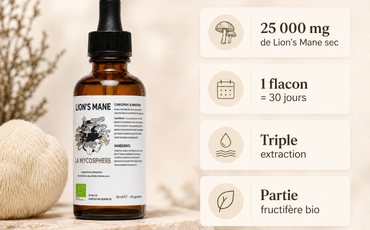
lion’s mane, Lion’s Mane, Lion’s Mane.
Shiitake mushrooms, oak mushrooms.
Nameko, Pholiota microspora.
Yellow oyster mushrooms, golden oyster mushrooms.
Eryngii, blue-knot mushroom, Argouane, Berigoule, Girboulot, false porcini.
White, gray, and blue oyster mushrooms; oyster-shaped oyster mushrooms; Pearl Oyster.
Italian oyster mushrooms.
Pink oyster mushrooms, salmon-colored oyster mushrooms.
Rough-ringed Stropharius, Wine-red Stropharius, Straw Porcini, Saketsubatake.

About the author
He has been working for several years on mycelium cultivation, organic mushrooms, and functional extracts. Through his articles, he shares practical expertise gained from the production, experimentation, and processing of mushrooms.
Discover the Mycosphere