
Chaga, scientifically known asInonotus obliquus, is a mushroom that grows primarily on birch trees in the cold regions of the Northern Hemisphere. Recognizable by its black, irregular surface, it has long been used in various traditions across Northern Europe and Asia.
Today, Chaga is gaining attention for its natural abundance of beneficial compounds such as polyphenols, beta-glucans, certain triterpenes, and melanin. In this article, we explain what Chaga is, why it is being studied, and how to easily incorporate it into your daily routine using a liquid extract .
What is Chaga?
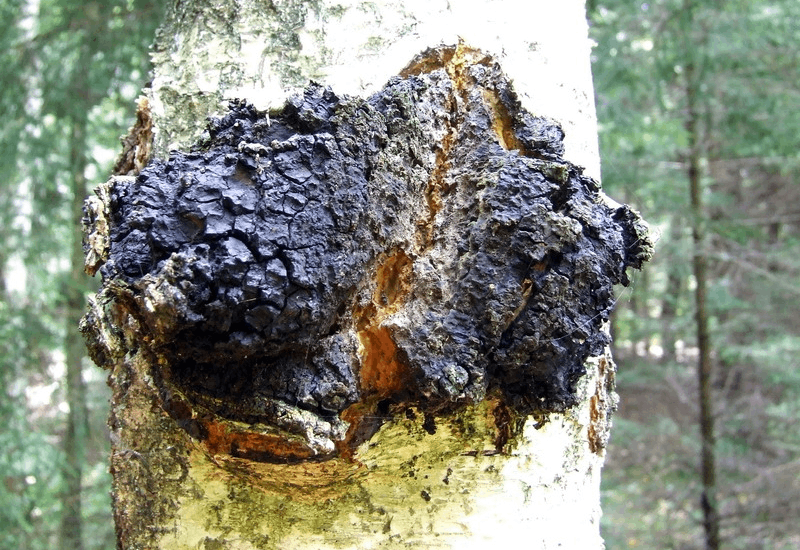
Chaga is a parasitic fungus that grows primarily on birch trees. The part that is harvested is not a cap-shaped mushroom, as is often imagined, but a sterile mass that forms on the tree trunk over several years.
This material naturally contains various compounds that are the subject of scientific research, including polysaccharides, beta-glucans, polyphenols, triterpenes, and melanin, which contributes to its very dark color.
A mushroom with a unique history
Chaga doesn't look like the mushrooms you usually pick in the forest. Its black, cracked surface gives it an almost charred appearance, while its interior has a distinctive orange-brown color.
It has a long history of traditional use in several boreal regions. A frequently told anecdote involves Finland during World War II: when coffee ran out, chaga was sometimes used as a substitute and brewed into a hot drink.
This story clearly illustrates the unique role of chaga: it is at once a forest resource, a traditional ingredient, and, today, a mushroom studied for the diversity of its natural compounds.
Check out our organic liquid extract
Made from organic Chaga harvested from the boreal forests of Northern Europe, our extract uses an advanced triple extraction process —CO₂, ethanol, and hot water—to extract the various naturally occurring compounds found in Chaga.
Each 30-ml bottle contains the equivalent of 36,000 mg of dried Chaga, which is a 30-day supply based on one pipette per day.
Why is Chaga generating so much interest?
Chaga is often classified as a "functional" mushroom due to its unique chemical profile. Scientific research is particularly focused on:
- its beta-glucans and other polysaccharides;
- its polyphenols, which have been studied for their antioxidant activity;
- its triterpenes, some of which come from the birch tree on which it grows;
- its melanin, which contributes to its very dark color.
As with many mushrooms currently being studied, the available data are promising but still largely based on preclinical studies. In Europe, health claims regarding food are strictly regulated; this is why we always distinguish between the compounds being studied and the effects that have been officially authorized.
Why choose an extract over a simple infusion?
Traditionally, chaga is often consumed as a decoction. Hot water helps extract certain water-soluble compounds, but other beneficial compounds are more effectively extracted using different methods.
That is why our Chaga extract is produced using a triple extraction process:
- CO₂, to work with certain lipophilic fractions;
- ethanol, to extract other alcohol-soluble compounds;
- hot water, for water-soluble fractions such as certain polysaccharides.
This process combines several complementary extraction methods into a liquid format that is easy to measure out and convenient for everyday use.

How can you incorporate Chaga into your daily routine?
Our organic Chagaliquid extract is designed for easy use: one 1-ml pipette per day, taken directly or diluted in a little water.
Each daily dose also provides 60 mg of vitamin C. Vitamin C supports the normal function of the immune system, a claim authorized in the European Union.
Its mild flavor makes it easy to incorporate into your daily routine, without any lengthy preparation or steeping.
A few ideas for incorporating Chaga into your routine
-
In a glass of water
The easiest way: Add one dropperful of Chaga extract to a glass of water, either in the morning or at any time during the day. -
In a hot drink
You can also add it to herbal tea or a hot drink, preferably after it has cooled slightly. -
In a gourmet drink
Its mild flavor profile pairs well with cocoa, plant-based beverages, or certain coffee-based drinks.
Why choose our Chaga extract?
- 36,000 mg of dried Chaga per 30-ml bottle;
- a 30-day treatment regimen of one pipette per day;
- Organic chaga from the boreal forests of Northern Europe;
- advanced triple extraction: CO₂, ethanol, and hot water;
- Vitamin C: 60 mg per daily dose;
- A liquid form that is easy to take and has a mild taste.
Discover our organic Chaga extract
Precautions for use
As with any food supplement, it is recommended that you follow the recommended daily dose. Dietary supplements are not a substitute for a varied and balanced diet or a healthy lifestyle. If you are undergoing medical treatment, are pregnant, or are breastfeeding, consult a healthcare professional before use.
Conclusion
Chaga is a unique mushroom that has long been valued and is now being studied for its rich array of natural compounds. While a decoction remains the traditional way to consume it,liquid extract a simpler and more convenient way to incorporate it into your daily routine, combining several complementary extraction methods.
Our organic Chaga extract was designed with this in mind: carefully selected raw materials, an advanced triple extraction process, and a convenient format that fits easily into your daily routine.
Scientific references
- Fordjour, E., et al. (2023). Chaga mushroom: a superfungus with countless facets and untapped potential. Frontiers in Pharmacology.
- Razumov, S., et al. (2020). Inonotus obliquus: ethnomycology and pharmacology. Phytotherapy Research.
- Teplyakova, T. V., et al. (2022). Biological activities and chemical composition of the Chaga mushroom. Biomedicine & Pharmacotherapy.
- Hwang, J. H., et al. (2019). Anti-cancer properties of the Chaga mushroom: a review. Journal of Ethnopharmacology.
- Géry, A., et al. (2018). Chaga (Inonotus obliquus): A potential future medicinal fungus in oncology? A chemical study and a comparison of cytotoxicity against human lung adenocarcinoma cells. Integrative Cancer Therapies.

About the author
He has been working for several years on mycelium cultivation, organic mushrooms, and functional extracts. Through his articles, he shares practical expertise gained from the production, experimentation, and processing of mushrooms.
Discover the Mycosphere


