Stropharia rugosoannulata, wine-red stropharia, king stropharia, or rough-ringed stropharia
The rough-ringed stropharia is very little marketed, yet it is an excellent mushroom. Its limited shelf life (3-4 days) compared to other mushrooms like shiitakes or button mushrooms probably explains this difference.
With its incredibly vigorous mycelium, it naturally and generously grows on wood chip piles.
It is a good mushroom for beginners because it colonizes substrates very quickly and can give good results in outdoor cultivation.
It integrates well into organic vegetable gardens or permaculture, for example.
What substrate for the King Stropharia?
It is generally cultivated on straw, wood chips, or sawdust.
Favor softwoods and avoid conifers (or mix them at a maximum of 25%).
You can make a mix of different carbonaceous materials. Straw will provide quick food for the mycelium, wood chips will be provisions for the long term, and sawdust will fill the gaps and retain more moisture in the substrate.
Avoid branches that are less suitable for this mushroom. For logs, consider oyster mushrooms or shiitakes, for example.
Stropharia is a primary and secondary decomposer. This means it will attack not only fresh materials (fresh wood chips, straw) but can also develop on materials that have already been partly decomposed by bacteria or other fungi (dead leaves, old mulch).
It is therefore robust and hardly affected by contamination. Stropharia enjoys being stimulated by soil microbiology and grows poorly under sterile laboratory conditions. However, to maximize success chances, we advise using the freshest possible materials and initially avoiding already decomposing materials. Soaking the straw or chips overnight in water will both properly moisten the substrate and partially rinse and clean it. By adding a cup of agricultural lime per 50 liters of water, you will raise the pH (make it more alkaline) of the substrate, thus limiting contamination risks from bacteria or molds while enriching the substrate with lime.
At the depth level, 15-20 cm is the optimal depth. A deeper bed may produce over a longer period, but it may take longer to yield the first mushrooms.
Where to plant it?
Like most mushrooms, stropharia prefers indirect light and semi-shaded places, but it can tolerate a few hours of sun per day. However, it fears dryness, so favor naturally moist areas in your garden.
Examples: forest edges, fruit tree bases, wood chip paths, vegetable mulching with dense foliage providing shade (potato, squash, etc).
When will I harvest?
In terms of timing, stropharia is very flexible. It can fruit from spring to autumn, with a temperature range from 10 to 22°.
They usually fruit within 2 to 4 months following inoculation.
How much mycelium for what surface area?
We generally recommend using about 10% mycelium relative to the wet substrate.
Example: an 8 kg bale of straw. Once moistened, it weighs between 25 and 30 kg (straw reaches about 70% moisture). A 3 kg bag of mycelium can therefore inoculate 1 small bale of straw, which can cover about 1.5 m².
Care
Once well established, the mycelium requires little maintenance apart from occasional watering. It can remain in place for several years if you maintain it by regularly adding new materials to decompose.
It is rather unpredictable; it is quite common to find mushrooms several meters away from where the mycelium was planted in the following years.
During prolonged dry periods, you can water it regularly (without flooding it, however).
You can take a portion of healthy mycelium once it has developed to inoculate other places and new materials with a ratio of about 20% mycelium.
The best periods for inoculation are spring and autumn. When planted in spring, it usually grows 2 months later just before summer and sometimes a second time in autumn. It can then produce for 2-3 years, depending on the type of materials and the quantity used.
How to do it?
Choose your substrate (straw, chips, sawdust) as fresh as possible.
This is the method we recommend most, suitable for most substrates.
- Roughly clear the ground. Some cultivate it semi-buried and therefore dig a small trench, which helps retain moisture better. Others cultivate it on the surface and cover it with a layer of soil.
- We usually start with a layer of cardboard, but it is not mandatory.
- Then put a first layer of wood chips/straw 5-10cm thick.
- Crumble the mycelium, spreading it evenly over the entire surface.
- Add another layer of substrate on top.
- Moisten with a 10L watering can per square meter. Depending on the dryness of the location, cover with a thin layer of soil (2-3cm), cardboard, tarp, or shade cloth.
When grown in a greenhouse, we recommend using a drip irrigation system.
Very easy method, but riskier.
-
Moisten the straw bale. You can soak it in water overnight, or water it with a watering can 2-3 times a day for 2-3 days.
-
Inoculate the bale by inserting small handfuls of mycelium all around inside the straw bale.
-
To prevent the straw from drying out, it is possible to partially cover the bale with soil, cover it with a tarp/shade cloth, and water regularly. Place the bale in a shaded area or under a shade cloth.
The risk of this method is on one hand the drying out of the bale which will prevent mushroom development, and on the other hand straw that is too wet which will suffocate the center of the bale and bring bacteria or molds. Make sure the bale is not wet but not soaked, and that the center of the bale remains aerated.
Select pots about 20 to 40 cm in diameter and height. Clean them well with soapy water. This method allows cultivation indoors or on a terrace, for example.
- Soak clean straw in a basin of water overnight. You can also add a cup of lime per 50 liters of water, which will raise the pH of the substrate and thus reduce the risk of contamination, while enriching the substrate with calcium.
- Mix the straw with the mycelium at a rate of 5 to 10% mycelium by fresh weight.
- Fill your pots leaving 5 cm of space at the top. Pack the straw as much as possible.
- You can stack several pots one on top of the other. Close the top with a lid to limit drying out.
- After 2 to 3 weeks, the straw should be colonized. You will now add a casing layer. This can be a mix of peat, sand, and soil, or simply potting soil. This layer not only helps maintain constant moisture but also brings bacteria that stimulate the mycelium to produce its fruiting bodies.
- Keep moist. 2 to 3 weeks later you should start to see oyster mushrooms.
Identification
The rough-ringed stropharia is an easy mushroom to recognize with the characteristics you will find below. Note, however, that like all mushrooms, its appearance can vary depending on environmental conditions.
If in doubt, refrain from eating it and first seek confirmation from an expert.
Its cap usually measures between 5 and 10 cm, but can reach up to 20 cm in diameter for the largest specimens. Convex at first, it flattens with age. As its name suggests, it has a wine-red color initially, which can turn light brown or beige at maturity, especially if it is dry.
Its stem is wide when young and appears smaller as the cap develops. The spore color is dark brown/purple.
Its flesh is white, firm, and thick.
Wikipedia description:
"The cap, which can measure up to 20 cm in diameter, is initially bell-shaped or convex, then flattens while often remaining slightly umbonate. It is somewhat viscid and irregularly covered with whitish veil remnants, then becomes cracked with age. It is mahogany to wine-violet when fresh, and progressively paler, tan, or even almost cream when aging, more yellow when dry. The margin is very distinctly rolled then curved, and long appendiculate with veil remnants. The gills are adnate and white, then gray-violet. The stipe, which is equal or sometimes clavate towards the base, measures between 5 and 18 cm long and 1 to 3 cm thick. It bears a persistent superior ring, broad and membranous, often segmented or toothed underneath and grooved or striated above. This ring is white but quickly blackened by the spore print. The base of the stem is connected to numerous white mycelial cords. Its surface is ochre-yellow and finely scaly above the ring, and glabrous or fibrillose below. The flesh is white, thick, and fairly firm. It has a mild or slightly bitter and radish-like flavor. Its smell is initially quite indistinct, more or less metallic, then similar to dried porcini as it ages. The spore print is very dark gray-purple."
Source: https://fr.wikipedia.org/wiki/Stropharia_rugosoannulata
What is the mycelium bag made of?
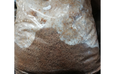
We supply the mycelium on a mixture of wood sawdust, straw, and grains. Thus, the mycelium having already encountered and digested these materials, will be able to recognize and colonize them more quickly afterwards. Indeed, when the mycelium encounters a new material it does not yet know, it can take a few days to find the right decomposition enzymes. However, the goal is for it to colonize its substrate as quickly as possible to avoid competition with other fungi. The addition of grains in the substrate will also boost the vigor of the mycelium to give it a better chance to establish quickly.

All our products are certified in organic farming "BE-BIO-01".

Our myceliums are produced under laboratory conditions, which ensures purity of the varieties and optimal quality.
Production time: 2-4 weeks. If we have it in stock, we ship it within the week.
À propos de l’auteur
Quentin Gobert
Fondateur de La Mycosphère
Passionate about the fungal world and a committed entrepreneur, Quentin shares his knowledge and expertise through articles and consulting. With the Mycosphere, he aims to raise public awareness about the importance of mushrooms in our ecosystems and to promote innovative solutions for a sustainable future.
Découvrir notre projet